
Hubsessed Office Hours - AI-Native - Oct 5, 2026
- Nico LafakisHost
- Trisha MerriamHost
Monday, October 5, 2026
Sign in to watch the full replay and read the transcript.
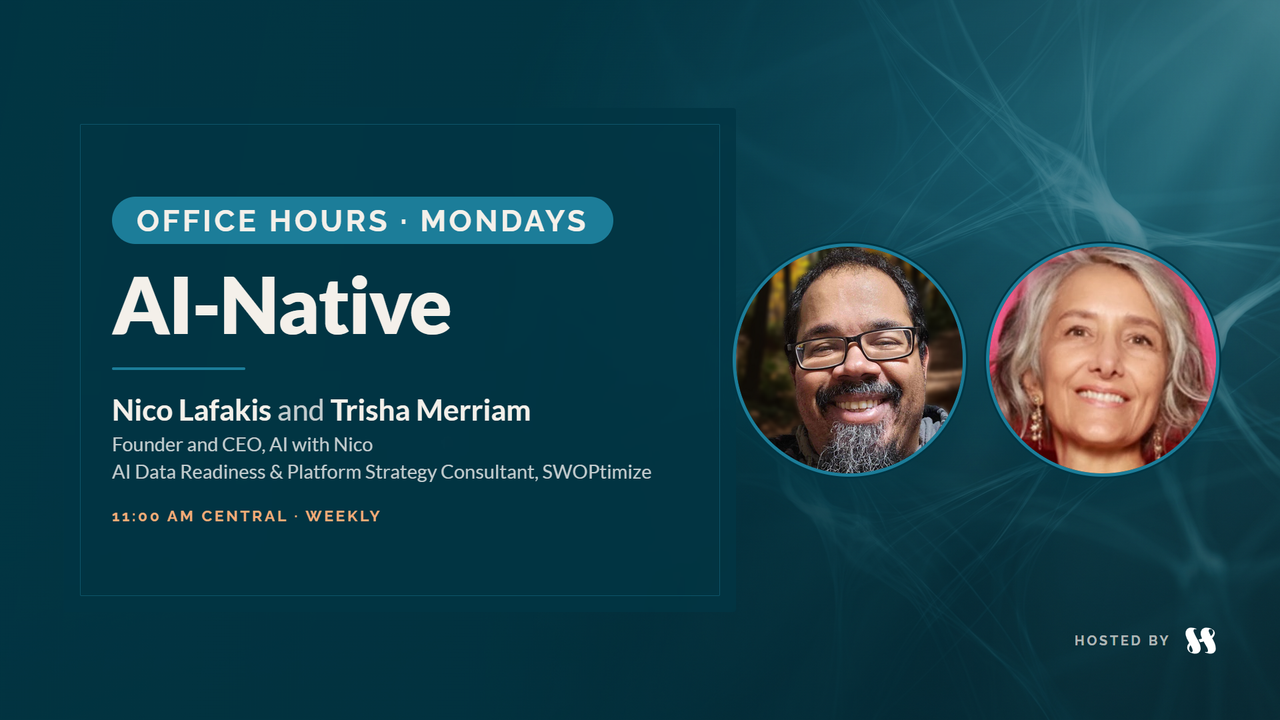
In the first Hubsessed Office Hours for AI-Native, Nico Lafakis and Trisha Merriam spend most of the hour on one attendee question: how do you get a HubSpot agent to follow a template the same way every time? Nico opens a customer lifetime value agent he built to show how he structures its instructions and rules, and when examples help, and Trisha shares her own writer and checker setup. They also cover Dots, agent-to-agent connections and reverse engineering your data.
Clips from this session
10 short cuts from this conversation.
Landscape
10 clipsAgents are tools in a toolboxReverse engineer it: matching sales reps to buyersA writer agent and a checker agentMarkdown headings tell the agent what matters mostPut a reviewer agent behind it, as a workflow actionAsking Breeze what model runs under the hoodReverse engineer itCall transcripts make reverse engineering easy nowReverse engineering: one rep, one product, or a coaching momentOne job per agent: why long jobs drift
Key takeaways
If two jobs would ever be used apart, give each its own agent and run them one after the other. One job per agent keeps the starting instructions from getting lost in a long run.
If it has to be one agent, the fix is in the instructions: markdown headings to signal importance, the role first and the goal second, and a defined scope, execution mode and method.
Keep a rule set of guardrails, and add a rule every time testing shows something you do not want.
Examples are the best way to get a fixed output, but one or two examples become the only shapes the model will use. If you cannot give several, describe the template precisely: columns and rows, headers and sections.
Pair a writer with a checker, or run a review agent as a workflow action so one reviewer can check several agents, and test what each run costs in credits.
Nico's distinction: an MCP connector lets your agent look at everything, while an agent-to-agent connection only talks to the agent that curates the information.
Reverse engineer your data. Start from the deals that were won and the relationships behind them to see which reps work best with which people, and build playbooks around people as well as companies.
Questions answered
Chapter times not yet verified
- 00:00Welcome: Nico and Trisha open the first AI-Native sessionTopic
- 03:34What Dots is, and why it feels like one assistant for everythingTopic
- 07:53Many HubSpot portals, many tools: can one assistant hold them all?Question
- 10:25Agent-to-agent and MCP, and checking before anything is sentTopic
- 12:47Models reaching the same level, and asking the right wayTopic
- 13:58How do I get a HubSpot agent to follow a template the same way every time?Question
- 16:58Inside a customer lifetime value agent, and the change to agent instructionsTopic
- 21:26Two agents: a writer and a checkerTopic
- 23:39Markdown headings, a rule set, and the role before the goalTopic
- 27:58Scope, examples, and a reviewer as a workflow actionTopic
- 35:39Do long instructions make an agent forget its rules?Question
- 38:28Knowledge as skills, and test, test, testTopic
- 44:09Asking Breeze which model runs under the hoodTopic
- 47:34Reverse engineer itTopic
- 48:38Matching sales reps to the people they work with bestTopic
- 53:21Playbooks built around peopleTopic
- 55:26Wrap: see you next MondayTopic
Resources
Related episodes
 Tuesday, October 6, 2026, with Casey Hawkins, Chris Carolan, and Ryan GinsbergAnother Orange Morning · Tuesday, October 6, 2026
 Monday, October 5, 2026, with Casey Hawkins, Chris Carolan, and Joshua OakesAnother Orange Morning · Monday, October 5, 2026
 Thursday, October 1, 2026, with Casey Hawkins, Chris Carolan, and Trisha MerriamAnother Orange Morning · Thursday, October 1, 2026